
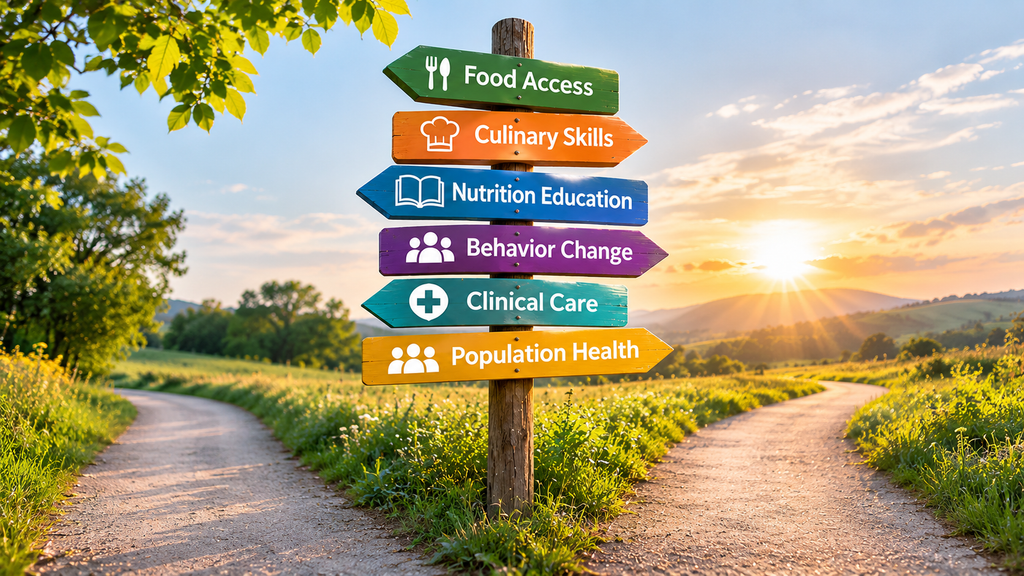
If we want to transform health, we need to challenge how we define the movement itself.
By Brenda Navin, RD | Founder & CEO, Launch My Health
Food Is Medicine is having a moment. And it’s about time.
The momentum is undeniable. Research is accelerating, policymakers are paying attention, healthcare organizations are investing, and conversations that once happened on the sidelines are finally moving into the mainstream.
The American Heart Association’s recently released Advances in the Food Is Medicine Field 2026 report highlights this progress, including 57 research studies published in just one year, a 68% increase from the previous year.
As a registered dietitian who has spent my career working in healthcare, and now as an entrepreneur building solutions in this space, I couldn’t be more excited.
But I also have a question that I believe we need to be asking.
What if we’re thinking too narrowly about Food Is Medicine?
And more importantly, what opportunities are we missing because of it?
Are We Defining the Movement by the Interventions?
The American Heart Association’s Health Care by Food initiative focuses on providing healthy food through interventions such as medically tailored meals, medically tailored groceries, and produce prescriptions to prevent, manage, or treat specific clinical conditions in coordination with healthcare.
These are critically important interventions. We absolutely need them.
For someone managing a complex chronic condition, facing food insecurity, or struggling to access nutritious food, these services can make a meaningful difference.
I applaud the organizations, researchers, and community partners advancing this work.
But here’s where I want to challenge our thinking.
Is providing food the definition of Food Is Medicine, or is it one important way we deliver it?
There’s a difference.
I understand why researchers and policymakers need clearly defined interventions. We need standards, evidence, reimbursement models, and consistency to scale solutions.
But a definition designed for reimbursement and research shouldn’t necessarily become the definition of an entire movement.
When we define Food Is Medicine primarily through the lens of food provision and clinical treatment, we risk overlooking an enormous part of the opportunity.
The opportunity to intervene earlier.
The opportunity to build knowledge, confidence, and practical skills.
The opportunity to help people make meaningful changes before they become patients with complex, expensive conditions.
And the opportunity to improve the health of entire populations, not just those who qualify for a particular intervention.
Why Do We Keep Waiting Until People Are Sick?
I’ve spent more than two decades working within healthcare, and one pattern continues to challenge me.
We are very good at building systems around illness.
We identify a condition. We establish eligibility criteria. We prescribe an intervention. We measure the clinical response.
And while we’ve made extraordinary advances in treating disease, we continue to struggle with preventing it.
Now, as Food Is Medicine gains traction, I see a familiar pattern emerging.
Much of the attention, funding, and infrastructure is focused on people who are already sick, medically vulnerable, or experiencing significant barriers to accessing food.
Again, these populations absolutely deserve our attention and investment.
But why must someone become sick or high-risk before we invest meaningfully in their nutritional health?
What about the 35-year-old who wants to improve how their family eats but doesn’t know where to start?
The employee who is experiencing early metabolic changes but hasn’t received a diagnosis?
The parent who wants to cook healthier meals but lacks the confidence, time, or practical skills?
The person who has access to healthy food but doesn’t understand how nutrition influences their long-term health?
These people may not qualify for a medically tailored meal or produce prescription.
But they represent an enormous opportunity to influence the trajectory of health.
If our goal is truly to improve health and avoid future healthcare costs, shouldn’t we be investing just as intentionally in people before they enter the healthcare system with preventable conditions?
Access Is Essential. But Access Alone Isn’t the Whole Answer.
We cannot talk about Food Is Medicine without addressing food insecurity, affordability, and access. These are foundational issues.
But access is only one piece of a much larger puzzle.
Having access to healthy food doesn’t automatically translate into healthier eating.
People also need to understand what to eat, why it matters, how to prepare it, and how to make it work within their own lives.
They need practical skills.
They need confidence.
They need solutions that reflect their culture, preferences, budget, family, and circumstances.
And they need support in turning knowledge into action.
This is where I believe culinary medicine, evidence-based nutrition education, behavior change, and community engagement deserve a much bigger place in the Food Is Medicine conversation.
We should be equally interested in building people’s ability to nourish themselves as we are in providing the nourishment.
One addresses an immediate need. The other can build capabilities that last a lifetime.
And for many people, both are necessary.
Imagine a Food Is Medicine ecosystem that connects food access with nutrition education, cooking skills, clinical support, and practical tools that help people sustain change.
Not as disconnected offerings, but as complementary parts of a larger strategy.
That’s where I see tremendous opportunity.
The Science Is Pointing Toward a Broader Approach
Interestingly, the American College of Cardiology’s September 2026 scientific statement, Food and Health: Nutrition for Prevention and Management of Cardiovascular Disease, reinforces the importance of looking beyond individual foods or nutrients.
The ACC emphasizes overall dietary quality and sustainable eating patterns as foundational to both preventing and managing cardiovascular disease.
Importantly, the statement calls for integrating dietary counseling, medical nutrition therapy, Food Is Medicine interventions, public policy, and clinician education into healthcare.
I see this as an encouraging step forward.
It recognizes that improving nutritional health requires more than a single intervention.
But I would challenge us to go even further.
What about teaching people how to cook? Helping them navigate food choices? Building confidence? Supporting small, achievable actions that eventually become lifelong habits?
We have decades of nutrition science demonstrating the importance of dietary patterns. The next challenge is translating that knowledge into something people can actually use in their everyday lives.
Knowing what a healthy diet looks like and knowing how to live it are two very different things.
If we want lasting change, we need to invest in both.
We Need to Think Beyond the Patient and Toward the Population
One of the most exciting opportunities in Food Is Medicine is its potential to reach far beyond traditional healthcare delivery.
What if we stopped thinking about nutrition primarily as something we prescribe after identifying a health problem?
What if we made it a foundational part of how we support health across entire communities?
Think about the possibilities.
Employers could help their workforce build healthier eating habits before chronic conditions develop.
Health plans could invest in nutrition education and early action alongside clinical interventions.
Healthcare systems could integrate nutrition into their broader population-health and community-health strategies.
Public health organizations could collaborate with healthcare, employers, schools, and community partners to build more connected approaches.
And we could engage people throughout their lives, not just when they meet a diagnosis or risk threshold.
This isn’t about choosing prevention over treatment.
It’s about recognizing that a truly effective Food Is Medicine strategy needs both.
We need medically tailored meals for people with complex medical needs.
We need produce prescriptions and food assistance for people facing access barriers.
We need registered dietitians providing individualized medical nutrition therapy.
And we need scalable, accessible nutrition education and culinary medicine that help people take action long before disease develops.
These approaches shouldn’t compete for a place in the movement.
They should strengthen one another.
Are We Measuring the Right Things?
As this field matures, we’re rightfully asking for stronger evidence, measurable outcomes, and financial sustainability.
But I believe we need to broaden how we think about value, too.
Clinical outcomes matter. Healthcare utilization matters. Cost-effectiveness matters.
But what about the actions that happen long before those outcomes appear?
What if someone improves the quality of their diet?
What if they learn to prepare healthy meals at home?
What if they develop the confidence to make better food choices?
What if they begin making small, sustainable changes that improve their health trajectory over time?
These aren’t insignificant outcomes simply because they don’t immediately show up as a reduction in hospital admissions or claims costs.
They’re often the beginning of meaningful change.
At Launch My Health, this is an area we’re particularly focused on: understanding and measuring the movement from knowledge to confidence, intention, and action.
We need to get better at recognizing the value of these upstream indicators while continuing to connect them to longer-term clinical and economic outcomes.
And we need to get serious about cost avoidance, not just cost reduction.
Cost reduction often asks what we can spend less on today.
Cost avoidance asks what future illness, complications, and healthcare spending we may be able to prevent through earlier action.
The distinction matters.
If we only value interventions that demonstrate relatively immediate savings among high-risk populations, we may systematically underinvest in the very strategies that could change the long-term trajectory of health.
Prevention requires patience, measurement, and a willingness to think beyond the next budget cycle.
A Challenge to the Food Is Medicine Community
I believe we’re at an important inflection point.
The science is advancing. The interest is growing. The investment is coming.
And we have an opportunity to shape what Food Is Medicine becomes.
So I want to challenge all of us working in this space, including myself, to stay curious.
Are we defining Food Is Medicine too narrowly?
Are we building a movement around the interventions we currently know how to fund, rather than the full range of interventions that could improve health?
Are the interventions financially sustainable? What is the funding model beyond a grant?
Are we creating another healthcare model that waits for people to become sick enough to qualify for help?
Are we giving prevention, education, culinary skills, and behavior change the attention they deserve?
And perhaps most importantly, are we asking communities what they actually need to build healthier lives, rather than designing solutions for them?
We need to be willing to ask uncomfortable questions, challenge traditional models, and invite different perspectives into the conversation.
That includes clinicians, researchers, public health leaders, community organizations, chefs, employers, health plans, educators, and the people we’re ultimately trying to serve.
No single intervention or organization has the whole answer.
Let’s Not Make the Movement Smaller Than the Opportunity
I am optimistic about the future of Food Is Medicine.
But I don’t want us to miss the bigger opportunity because we’re too focused on defining the smaller one.
We can create precise definitions for specific clinical interventions without limiting the vision of the broader movement.
We can support the most vulnerable while also investing in the health of entire populations.
We can address immediate nutritional needs while building lifelong skills and healthier behaviors.
And we can recognize that food is more than something we provide to treat disease. It’s something people interact with every single day, influencing their health over a lifetime.
Food Is Medicine should be about more than helping people manage disease. It should be about creating a future where fewer people develop preventable disease in the first place.
That requires us to think bigger, collaborate differently, and measure what matters across the entire continuum of health.
The momentum is here.
For me the question are we thinking big enough!
References
- American Heart Association, Health Care by Food. Advances in the Food Is Medicine Field 2026. September 2026. https://www.healthcarexfood.org/en/-/media/Files/HCxF/Resource-Hub/Advances/Advances-in-the-Food-Is-Medicine-Field-2026.pdf
- Hu FB, Beleslin B, Blaha MJ, et al. Food and Health: Nutrition for Prevention and Management of Cardiovascular Disease: 2026 ACC Scientific Statement. Journal of the American College of Cardiology. Published September 30, 2026. https://doi.org/10.1016/j.jacc.2026.08.025