
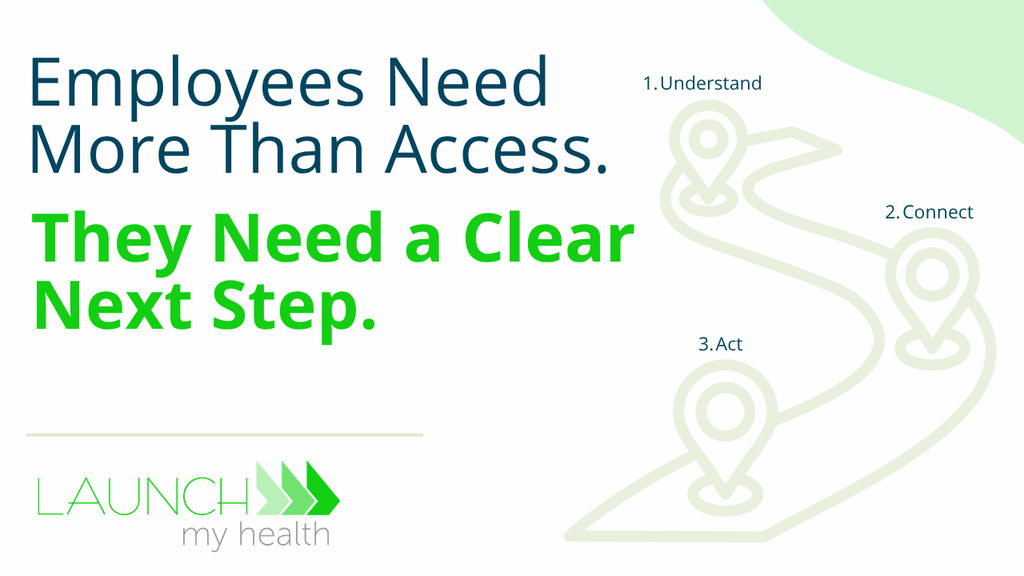
Workplace wellbeing has made tremendous progress in giving employees access to health information.
That matters. Employees need credible, practical education that helps them better understand their health and the choices they make every day.
The next challenge is making that information easier to use.
Someone who wants to eat better may be hearing about blood sugar, protein, fiber, inflammation, gut health, ultra-processed foods, meal preparation and metabolic health at the same time. Much of that information may be useful. The harder part is often knowing what is most relevant, where to begin and what to actually do next.
That creates an important opportunity for employers.
Access matters. Relevance determines what happens next.
For years, one measure of a strong digital wellbeing solution has been the breadth of what employees can access. How many topics does it cover? How much education is available? Can employees find resources that reflect the health issues they care about?
Those are still important questions.
But access alone does not guarantee that an employee knows which resource is most useful right now. The experience becomes more valuable when credible information is paired with enough context and guidance to help someone identify a logical next step.
That is where education becomes easier to act on.
Employers are trying to solve this at scale
Personalization sounds relatively simple when we talk about one person. It becomes much harder when an employer is trying to support 5,000, 20,000 or 100,000 people with different schedules, health interests, work environments, cultures and levels of readiness.
The employee in a corporate office may need something completely different from the employee working overnight in a hospital, driving between customer locations or starting a shift in a manufacturing plant.
HR cannot curate a health journey for every individual. Nor should it have to.
The challenge is creating an experience that can feel relevant to the employee without creating another administrative burden for the employer.
Better information is only part of the answer
We have been thinking about this quite a bit at Launch My Health.
Our work has always centered on practical nutrition education: helping people understand not only what may support their health, but how to actually put it into practice.
Increasingly, we are also thinking about the step that happens before and after the education. How do we help someone recognize what may be most useful to them right now? How do we help them connect what they learn to something they can actually do?
A short interaction can help create awareness. A relevant recommendation can provide a logical starting point. Skills-based education can then help someone understand the why and the how. Continued guidance can make it easier to decide what comes next.
That progression is increasingly how we think about behavior change: Understand. Learn. Apply. Practice. Measure.
None of those steps replaces good health information. They make it more useful.
From engagement to action
There is another reason this shift deserves attention.
Employers are under increasing pressure to understand whether the health and wellbeing programs they purchase are actually creating value.
Participation still matters. Engagement still matters. Neither one tells the whole story.
If someone logs into a platform, watches a video and leaves, we know they engaged. If that same person identifies an area they want to improve, learns a practical skill and starts doing something differently, we are getting closer to the reason the benefit exists in the first place.
That is a much more meaningful progression.
The goal is not simply to put more information in front of an employee. It is to provide credible education in a way that helps someone move from “I know this matters” to “I know what I can do next.”
A better question for employers
Health education remains essential. The opportunity now is to make it more relevant, more practical and easier to put into action.
So when employers evaluate a wellbeing solution, the question should not stop at “What information can employees access?”
It should also include: How well does the experience help someone understand what is relevant and take the next step?
That is the standard we are increasingly designing around at Launch My Health.